Friday, 7 July 2023

A Mid-year Review

Great White Egret (c) Darrell Wood

We are half-way through this year and I find with some embarrassment and surprise that I haven’t posted a blog since February. It sometimes feels as though time has accelerated and I have been left in its slipstream. It is not as if there has been nothing to talk about, the list of birds seen on the moor has exceeded that of previous years by mid-summer. It now stands at 152 species. 

Black-winged Stilt courtesy of Rob Cadd.

They include some major rarities such as Black-winged Stilt, Spotted Crake, Night Heron, Long-eared Owl and Montague’s Harrier. The Heron and the Stilt being firsts for the reserve (the previous Night Heron was regarded as an escape).

Night Heron courtesy of Jeremy Dexter.

My lack of posting has been much more to do with my difficulty in trying to find new things to say and to saying things in a fresh way. I have been writing this blog since 2011. In response to several enquiries and requests I will try to resume perhaps on a monthly basis.

Goldfinch (c) Bark

We are now entering what many birders regard as the quietest and least exciting time of the year, sometimes referred to as the summer doldrums.


Comma and Pied Hover-fly . (c) Bark

And to disprove this misconception there is still plenty to see, hear and experience on Otmoor.


Cuckoos (c) Bark

Last weekend there were still Cuckoos calling and flying across the reserve . There have at times been up to a maximum of six present including a hepatic female. The adults will all have left by the time this blog is published, but we can look and listen for the juvenile birds emerging from the  nests of their foster parents and being fed out in the bushes before they too make the difficult flight down to the Congo Basin in Central Africa.


Little and Large (c) Bark

All three species of Egret were on display last weekend with an elegant Great White at the first screen hunting in the shallows, a number of Little Egrets pottering about the lagoons and up to six Cattle Egrets accompanying the cows out on Greenaway’s and Closes.

Reed Warbler and food for chicks (c) Bark

The Warbler species across the moor are either busily collecting food to feed young or singing again to advertise for mates or to establish territory for second broods. Grasshopper Warblers were reeling from Morleys, the Pill area and out on Greenaways, last weekend.


Singing Garden Warbler and Sedge Warbler (c) Bark

The ducks are starting to look very scruffy as they moult into their eclipse plumages. There have been a pair of Garganey on the lagoon in front of the first screen and there have also been lots of family groups of young ducks and ducklings with many broods of Shovellers to be seen, as well as a few broods of Pochard, Gadwall and Tufted Ducks.

Female Shoveller and four Trowels! (c) Bark

Female Bitterns are now making their characteristic feeding flights to and from the nest locations. It is thought that there are two different nests in the reedbed and another out in one of the smaller reedbeds on Greenaway’s.

An anxious Redshank (c) Bark

It is believed that there is still some nesting activity going on from the Marsh Harriers, but numbers are ambiguous after the regular adult male from the reedbed, who last year serviced two different nests that both raised youngsters, disappeared.

Crane pair from the Wetland Watch (c) Bark

Cranes are still present and are quite unpredictable, the loss of Maple Glory and her nest and eggs was a huge blow after the success of last year and it has been very difficult to keep track of how many Cranes have been on site and just which Cranes in particular, we have been seeing. Only one of our regular birds is still identifiable through his leg rings.

Grasshoppers are thriving on the grasslands (c) Bark

It is proving to be a good Quail year with a number of calling birds across the site. One very lucky Otmoor regular actually saw one of these elusive and secretive birds whilst out running across the Hundred Acre Field to the north of the reserve. We have also recorded Grey Partridges in The Closes, a species that was not seen at all last year.

Within the next few weeks, we will see the arrival of some of our early autumn passage migrants, such as Whinchats and Wheatears. There will be a number of Redstarts that will spend several weeks feeding up before undertaking the next stage of their migration. We might very well see some returning waders stopping over to feed before moving on. This time of the year is certainly quieter but never without interest.

A Skipper (c) Bark

Butterfly enthusiasts will be out in force looking for our special species like Brown Hairstreaks, that are regularly found along the Roman Road.


Hay Meadows are at their most flowery (c) Bark

Monday, 27 February 2023

February round-up and spring on its way.

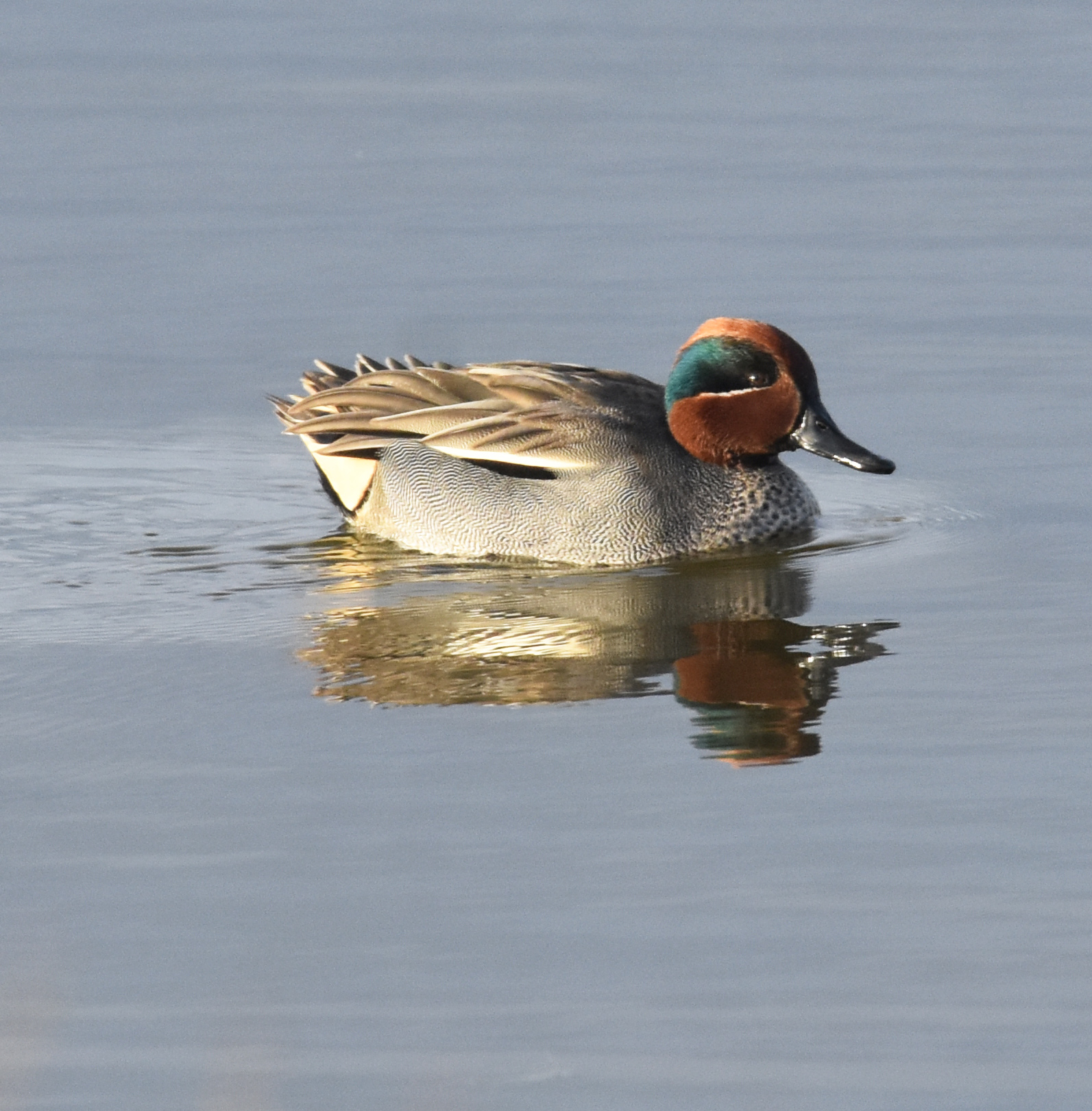
Sparkling Male Teal (c) Bark

The colder weather of early in the month has given way to much milder conditions with fewer frosts and the frozen water bodies have thawed. As often happens at this time of year the Starling roost has collapsed, and they have moved elsewhere.
Thousands of Golden Plover (c) Bark

Despite the absence of all the Starlings, Otmoor is still hosting well over fifteen thousand birds. This number is made up by nearly five thousand Lapwings and five and a half thousand Golden Plover. Teal and Wigeon together number over four thousand and the other duck species make almost another thousand.  

Lapwings (c) Bark

(these figures come from the WEBS count taken this Monday 20th February, by the RSPB staff.) The count does not include the fluctuating flocks of feral Geese that are currently scattered across the moor and surrounding farmland.


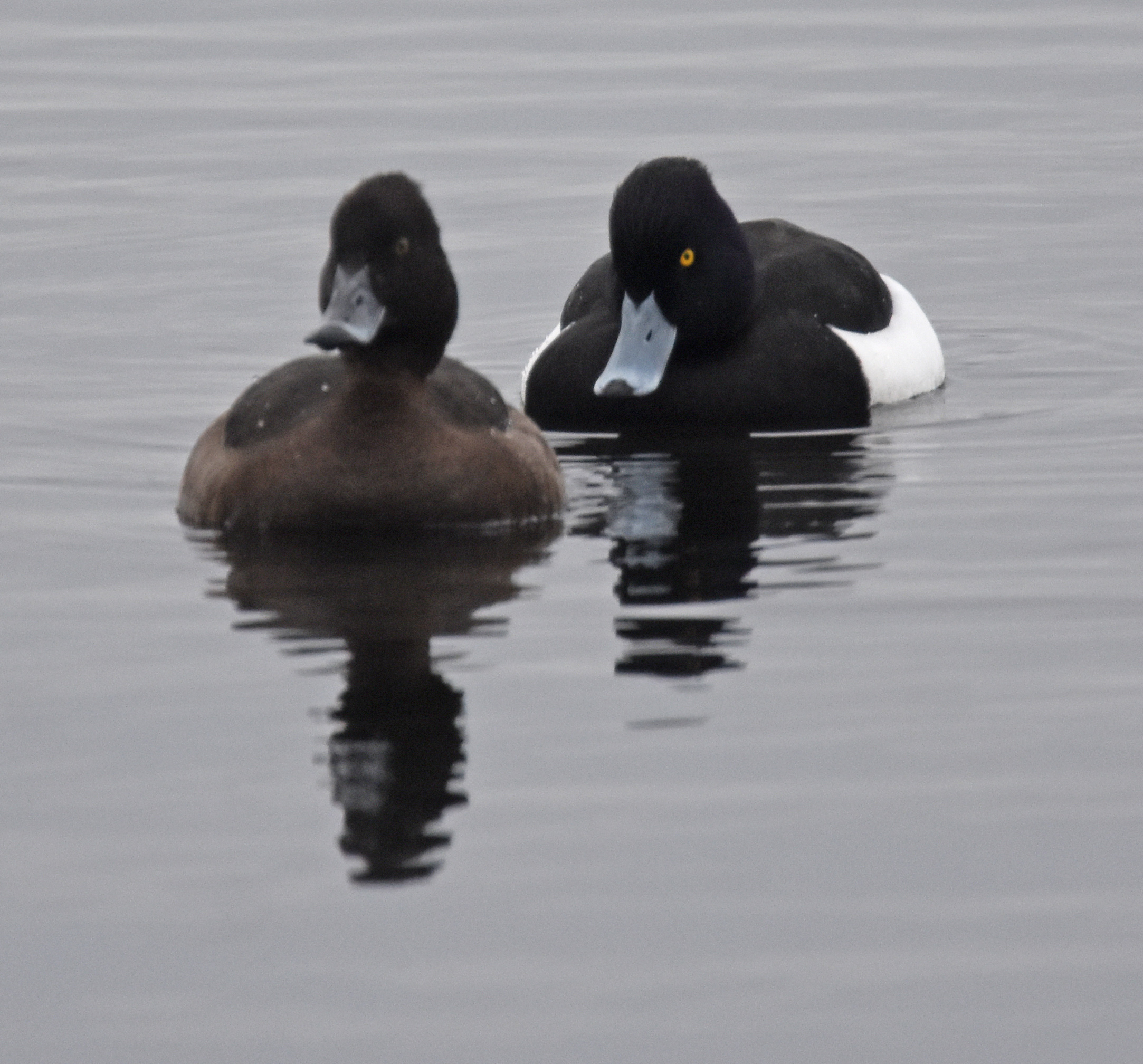
Amorous Tufted Ducks and a breeding plumage Pochard (c) Bark

Bald numbers however do not do justice to the sheer spectacle of seeing so many birds flushing in response to hunting raptors or to other threats, real or imagined. It is sometimes possible to track the progress of a raptor hunting across the fields as flock after flock takes off in panic at its passage. At times the sky seems to be full of birds in every direction one looks.

Marsh Harrier (c) Dan Miller

The Lapwings and Golden Plover show different behaviours in their response to threats, with the Goldies flying tighter with more twists and turns, they fly higher and form loose skeins as they start to settle again. The Lapwings however spread out much more and their flocks are looser. On days when there is bright light in the south and lowering indigo clouds in the north the birds twinkle and sparkle as they turn in the sky flashing black and white.


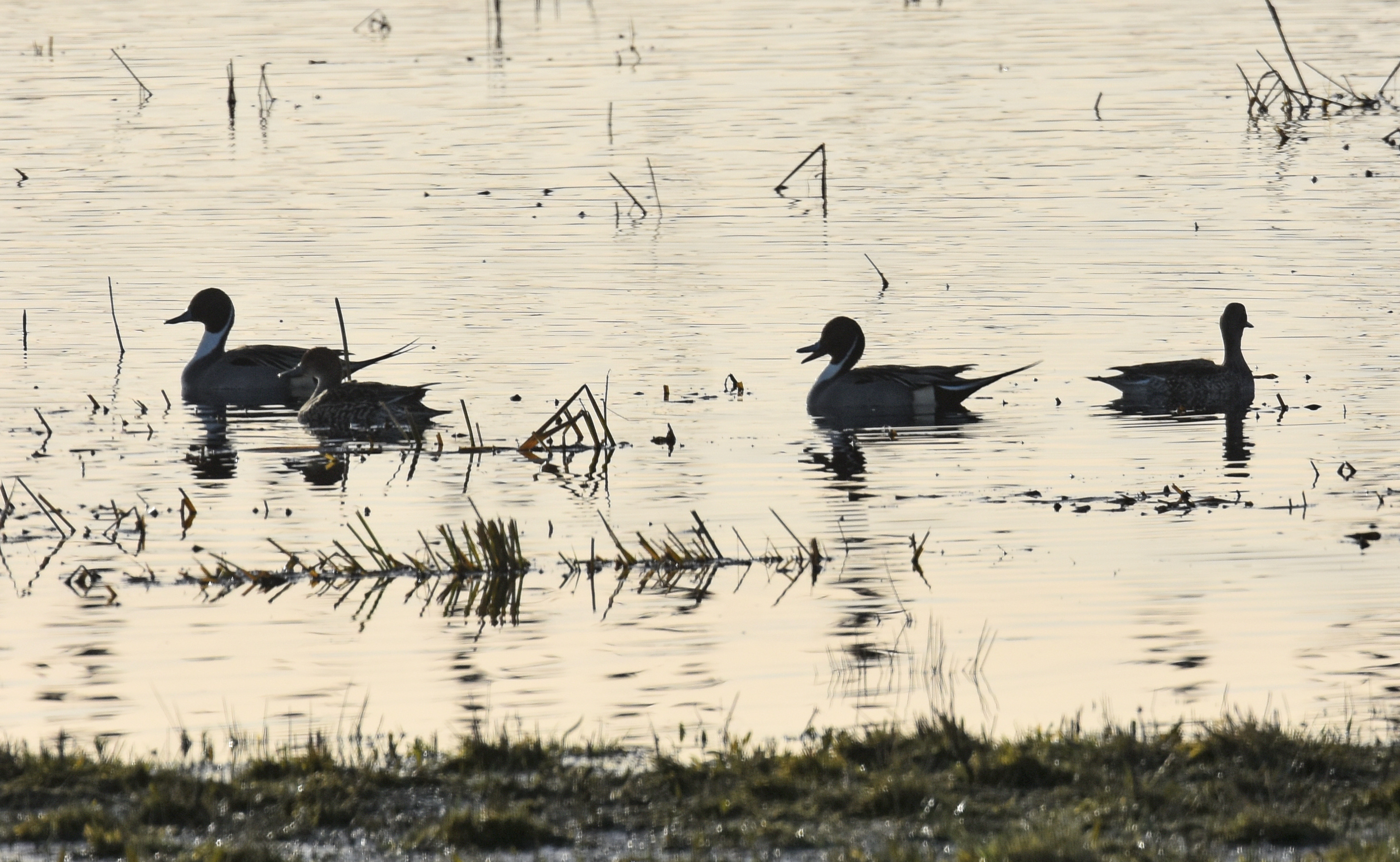
Pintail in silhouette (c) Bark

Last Saturday we were helping a group of the Otmoor Volunteers with some winter id tips followed by a walk out to the reedbed to put the talk into practice. I had produced a Power Point presentation to illustrate some aspects of the id issues raised. My penultimate slide showed the difference between Eurasian Teal and Green-winged Teal and the difference between Eurasian Wigeon and American Wigeon. It mentioned that there had been an American wigeon at Port Meadow briefly and so it would be worth looking carefully at any Wigeon on the moor. I also explained that an American Wigeon would be a first record for Otmoor. We duly carried out our walk and spent some time scoping through the massive flocks of birds out on the Flood Field. We found the Black Swan that was also mentioned in the presentation, which I had not realised was there, but we failed to spot the American Wigeon. 

American Wigeon courtesy of Badger.

The bird was found by Fergus Mosey, the RSPB warden, whilst doing the WEBS count last Monday morning. It was seen occasionally during the day although the light was difficult and again on the next day. It has been seen intermittently throughout the past week sometimes on Big Otmoor and more regularly on The Flood.

Ted and partner ,Barn Field. (c) Bark

There are currently five Cranes on the moor a pair and last years successful pair with their offspring still in tow. They are very vocal at the moment and often announce the fact that they about to fly by bugling loudly. It may be that the pair with the juvenile may try to push it away now, if they are to breed again this year.

Coot wars are breaking out across the lagoons. (c) Dan Miller

There seems to be two clear territories with some common ground in between a lot of the bugling is about establishing boundaries. It will be interesting to watch the evolving soap opera as it develops during the spring, and to see if the cast is supplemented by any further pairs or singletons.


Long Tailed Tit with a tiny spider prey. (c) Bark

This month just as we expected and right on cue Redshank and Curlew have returned. There are only a few Redshank at present but there were thirteen Curlew recorded on Monday. An Oystercatcher has been seen and several Dunlin. The water levels are looking good for passage waders and the centre of Big Otmoor is looking as though it will soon become the Otmoor “hotspot”. It is very well worth checking it out from now onwards for early returning Garganey.


Lots of mammals, a very confiding Muntjac, a quicksilver Weasel and a mad Hare (c) Bark

It has been an exciting week and the Otmoor list now stands at ninety seven species, the only downside of the latest find on the Reserve is that it has made my “Birds of Otmoor” booklet outdated once again !


Wednesday, 1 February 2023

Birds on a Branch......and January Update.

The Branch

There is a row of mature oak trees that forms the border between the path beside the reedbed and Big Otmoor. One of these old trees, the nearest to the first screen, has a twisted, scarred and naked branch that reaches above the canopy.


Used by everything from Kites to Blue Tits

This branch has a deeply etched surface and a jagged shape not unlike a negative image of a bolt of lightning.

Its height and position mean it is a superb lookout point, a song-post from which to broadcast calls or perhaps just a safe staging post along the hedge.


Cuckoos use it to broadcast their calls.

Over the years I and many other birders have seen a variety of different birds taking advantage of this perch, from Red Kites at one extreme to Blue Tits at the other and indeed many species in between.

Both common Woodpeckers use it.

We have photographed them when we could although some of the more unusual birds were missed, like a Merlin that flew just as I lifted the camera, or the Hoopoe seen in June 2008.

 Kestrels hunt from it.

Starlings use it when they come out of the roost.


 Passage Wheatears and newly arrived Swallows perch there.


It really is an Otmoor icon!

I have not added individual credits to these images for fear of getting accreditations wrong, suffice to say that some of the images are mine, some JR's, some Mark Chivers and one at least Trish Millers. If anyone has images of any other suitable birds I would love to add them to this blog entry. Bark.


Hungry Fieldfare (c) JR

January Roundup. .

Mallard over a frozen reedbed (c)Bark  


A period of thaw and freeze with the latest freeze just having ended after a couple of hard frosty weeks. Water bodies across the moor were rock solid  with just the ring ditch still flowing. There is now a lot of water across the reserve, with the flood field finally living up to its 
   
 Lapwings and Goldies

Before the latest  freeze bird numbers had risen to an estimated ten thousand birds across the whole moor. There were at least three thousand Golden Plover and a similar number of Lapwings, the remaining numbers were made up of wildfowl. Five or six hundred feral Geese are grazing across Ashgrave and Big Otmoor and there several thousand ducks with over a thousand Teal and a slightly smaller number of Wigeon. Shoveller numbers finally went up, having been uncharacteristically low during the late autumn. In addition to the birds I’ve just mentioned there were at least fifty thousand Starlings arriving each night to roost in the reedbed.


  Snipe have  stuck it out (c) Darrell Woods
   
During the latest ten day freeze the majority of waders and wildfowl left the moor for the rivers or areas of deeper open water. They now appear to have returned and last weekend we estimated that there were over seventy Pintail amongst the other duck species.

   
Luke and Friends. 

Another returnee is “our” leuchistic drake Pochard “Luke”. We have been reporting on him and watching him since 2015, he was out on the northern lagoon with three other drake Pochards. Golden Plover and Lapwing numbers have not got back to where they were yet but are well on their way and February is usually when we see their numbers peak. The first Ruff of the year were also reported last weekend and it will not be long now before we see and hear returning Curlew.


We heard a couple of Cetti’s calling on Sunday along the bridleway and by the path to the second screen a reassuring thing to hear after a string of days when the temperature failed to get above zero. The Starling roost appears to have collapsed now as is normal after a spell of very cold weather. When the water across the reedbed freezes roosting birds are vulnerable to predation from mammalian predators coming across the ice and taking them from below.


 Yellowhammer (C) TomNL

We are still seeing similar numbers of raptors across the moor including the Ring-tailed Harrier, Peregrines and Merlin. The winter finch feeding programme is attracting large numbers of Linnets, Reed Buntings and Chaffinches, along with a scattering of other seed eaters. They in turn are attracting Sparrowhawks in search of an easy meal.
Waiting for lunch

The reed cut that has been carried out in the southern reedbed does not seem to have pushed the otters away although they were not so visible or  obvious during the freeze. They have attracted large numbers of people to see them and almost become stars on social media!


Young Otter (c) Bark