Tuesday, 9 April 2019

Saturday and Sunday 6th and 7th April

White Stork (c) Bark

It’s been some since we found a scarce Bird on Otmoor, so it was a thrill to find a White Stork on Sunday morning. We were half way along the bridleway back from yet another abortive attempt to find any Wheatears at Noke, when JR noticed a large bird circling Big Otmoor. A glance with bins revealed it was clearly a White Stork and not as we first assumed a Crane. Its’ circuit brought it closer and its huge broad wingspan made it look a bit like a flying door! It circled for a couple of minutes, as if it might land but then vectored off towards Ashgrave, descending as it went.

White Stork (c) JR
We hurried to get to a spot where we could overlook Ashgrave but there were no large birds other than geese to be seen. We met a couple of visitors who said that they had seen a large bird they had taken to be a Crane heading out across Closes (they were very pleased to find out that it was a White Stork as they had seen Crane before and Stork was a lifer for them!) Further long the bridleway we met a man who complained that, “There’s not much about…it’s a bit dead” when I told him about the Stork he said he did see a funny looking heron heading over towards the MOD land. Several birders came down to the moor to look for it and spent some time checking out the areas to the east of the reserve, sadly it was not re-found. Today I discovered that it had in fact landed on a field that is adjacent to the range and not publicly accessible and was seen there by the range warden. It was feeding in the middle of the field for approximately an hour. Later that afternoon a White Stork was reported over Sturdy’s Castle heading towards Blenheim. It’s a great pity that more people didn’t catch up with it.


Willow Warblers and a Chiffy (c) Bark
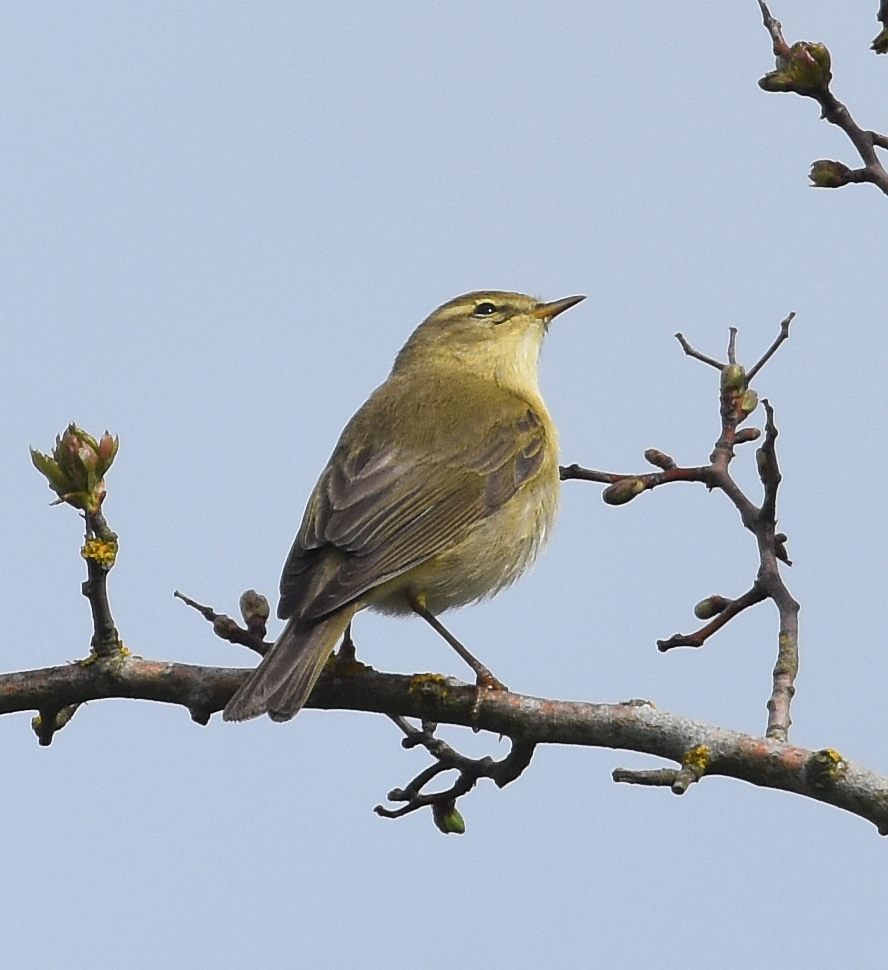
This weekend I heard and saw my first Willow and Sedge Warblers of the year. The Willow on the far side of the moor and the Sedge by the entrance to the trail to the first screen. Despite the cool misty weather, it was notable how much birdsong could be heard.

Lapwing (c) Tom N-L   and Curlew (c) Bark
Lapwings and Curlews calling over Greenaways. From the hedgerows and thickets Dunnocks, Chaffinches and Linnets are doing their utmost to attract mates and hold territory. When walking around the reserve Cetti’s Warblers can be heard shouting from the hedges and bramble patches.
Robin nest building (c) Bark
Their strident calls seem to be stimulated by movement as you pass their individual territory and they appear to escort you to the edge of their patch. I believe that we have more of them on the reserve than ever before. The milder winter has helped them, and it is only five years ago that they were completely wiped out across the moor.
Skulking Cetti's (c) Bark
We saw a male Peregrine on both days this weekend, for some of the time it was perched out on one of the posts on Greenaways. The Marsh Harriers were very active over both the reedbed and the adjoining fields, several food passes were seen between the male and female. During the last couple of weeks two Short-eared Owls have been seen regularly hunting over Greenaways in the early evening.

S.E.O (c) Tezzer    and Buzzard (c) JR

On Saturday we walked right around the moor and over at the western edge we found a flock of seventeen yellowhammers feeding on a recently ploughed and harrowed field. The males standing out vividly against the dark brown soil.
Yellowhammer at Oddington (c) Bark
There is still a flock of sixty Linnets coming in to take advantage of the seed being scattered by the hide, whilst elsewhere others are holding territory and setting about breeding.

Linnets (c) JR
Brown Hares were very active across Greenaways and Big Otmoor, chasing and boxing. When they take off on a run their extraordinary pace and manoeuvrability can be seen and appreciated.

Brown Hares     above (c) JR       below (c) Bark

Last time I suggested that this week I would be able to report the arrival of Sedge and Willow Warblers, which came to pass almost as I published my blog, I am sure that we will have other new arrivals to report in my next posting.
Calling Great Crested Grebe (c) JR


Tuesday, 2 April 2019

Saturday and Sunday 30th and 31st March

Dunnock (c) Bark

Huge contrast between the two mornings this weekend, on Saturday by ten o clock I realised was wearing one fleece too many on and on Sunday morning one too few. Saturday warm and sunny by contrast Sunday was grey with a cold easterly wind.
Chiffy (c) JR

As I got out of the car on Saturday, I heard my first Blackcap of the year singing from the Roman Road and then again along the bridleway. Chiffchaffs are getting going properly now and there were five or six calling repetitively across the reserve.
Garganey pair (c) Tezzer
We were keen to get out to the first screen to see if the pair of Garganey from the previous evening were still there but disappointingly they had moved on and were not seen again all weekend.
There was still lots to see and enjoy.

Flying Bittern (c) Above (c) JR below (c) Tezzer
A Bittern was seen on the edge of the reeds directly out from the first screen. It moved along the edge appearing and disappearing, showing just how cryptic its plumage can be. Eventually it flew low across the water and disappeared for good into the south eastern corner of the reedbed, its flight prompting a machine gun like volley of shutter releases. From the photos that I have seen the bird appears to have bluish lores which I understand suggest it is a male.

Tufty (c) JR               Teal (c) Bark
All of the male ducks are looking very smart and our regular leuchistic drake Pochard seems to be holding his own amongst the other drakes, despite looking very different. Tufted Ducks and Teal drakes are absolutely looking at their best.

"Luke"  the leuchistic Pochard (c) JR

There are probably four Marsh Harriers present at the moment and they are hunting over the reedbeds and out across big Otmoor and Ashgrave. We had a close encounter with a Peregrine on Saturday morning when one passed very low just over our heads as we made our way through the carpark towards the bridleway. It was probably a male as it appeared relatively small.
Marsh Harrier (c) JR

Curlew, Lapwings, Oystercatchers and Redshank are all adding their voices to the Otmoor soundscape. There were five Oystercatchers present on Saturday morning and I saw four Curlew displaying over the northern part of Greenaways and the MOD land. There are many of pairs of Redshanks across the reserve including two pairs that are frequenting the scrapes in front of the hide often feeding right in front of it, close enough to make it possible to appreciate the subtle detailed beauty of their plumage.

Redshank (c) Bark

The Linnet flock is showing little sign of shrinking, although there are fewer Reed buntings and Chaffinches taking advantage of the free handouts. On Sunday they were accompanied by a Red-legged Partridge!
Red Legged Partridge (c) JR

On Saturday the sun was beginning to bring out the Grass Snakes in increasing numbers. We talked to an expert herpetologist who believed that there was nowhere better in the UK to see so many and so reliably. The Common Lizards too were once again taking advantage of the sun to raise their metabolic rates.

Common Lizard (c) Bark     Grass Snake (c) JR

We are expecting a cooler wetter week and it might well push down some migrant waders, next week I hope that I will be able to  report our first Willow and Sedge Warblers of the year.

Reed Bunting and Dunnock (c) Bark


Tuesday, 26 March 2019

".....and out like a lamb." second half of March.

Sparrowhawk (c) Bark

I was fortunate to be overseas and to miss the worst of the stormy winds and rain of early March, as described so perfectly by Steve’s post: “In like a lion….” The change when I finally got back down to the moor was massive. The spring that was just being hinted at in late February and early March has truly arrived. There are leaves bursting in the hedgerows, Blackthorn starting into flower, Pussy Willow bright yellow with pollen and Coltsfoot in flower along the bridleway.


Spring signs (c) Bark

We saw the first Swallows on the 16th March flying low across Big Otmoor and this last weekend Sand Martins were seen on both days. This was unusual as most years Sand Martins usually the first hirundines of spring.
Big Otmoor Oystercatchers (c) Bark

More waders are being seen, last weekend there were nineteen Black-tailed Godwits over the first screen and out onto Big Otmoor. Two Ringed Plovers were seen out on the same field in the middle of last week and a Little-ringed Plover was seen on Sunday. Ruff and Dunlins have also been reported. At least four Oystercatchers are on site.
Blackwits (c) Pete Roby

Curlew (c) Bark
Curlew are making their evocative calls and circling over Greenaways and the MOD land. Redshanks seem to be feeding around the edges of almost every pool. Lapwings are displaying and calling across the whole reserve looping and diving in what looks to be to be a totally reckless way.
Redshank (c) Bark
Large numbers of seed eating birds are still coming to the food that we are putting out beside the hide. A Brambling was heard and seen briefly along the bridleway last week. This is a difficult time of year for finches as the first herbs and grasses are yet to flower and set seed, and with no stubbles and tiny field margins, supplies out in the wider countryside are largely exhausted.

Yellowhammer and Reed Bunting (c) Bark

Resident birds are pairing up and building nests. The first Chiffchaffs are calling in the carpark field and others still moving through can be spotted feeding in the hedgerows.
Chiffy (c) Bark

Nest building Wren (c) Bark
On Sunday this weekend I heard seven different Cetti’s Warblers calling between the carpark and the second screen, there will certainly be more than these when taken over the whole reserve. The first Wheatear was seen out on the Noke sheep fields on Saturday morning and doubtless there will be more of them coming through in the next few weeks, they really favour the short grass fields.
Marsh Harriers are displaying over the reedbed with two different females and a male present this weekend.
Sprawk (c) Bark
Last weekend as walked out to the Pill I flushed a Sparrowhawk out of the hedge it flew up but didn’t go far and when I returned, I flushed it again from the same place where I saw was feeding on a Wood pigeon. It was good to see this super predator so well and so close.
Some of the hundreds of Black Headed Gulls on big Otmoor (c) Bark

There is a huge flock of Black-headed Gulls on Big Otmoor. Many of them are starting to display and take up nesting territory. This weekend there were two Mediterranean Gulls amongst them one a second winter bird and the other an adult. It is very difficult to pick them out from the throng of the commoner black-headed Gulls. So far this year we have avoided the invasion of non-breeding subadult Herring and Lesser Black-backed Gulls. They might well have had an impact on the breeding success of our waders last year.
Common Lizard (c) Tezzer

Common Lizards were out sunning themselves at the first screen and as Sunday warmed up Grass Snakes could be seen basking on the dead reeds beside the bridleway.
The next few weeks are amongst the most exciting of the birding year, full as they are of arrivals and departures. Once again the moor will overflow with birdsong and be busy with urgent breeding activity.
Amourous Pochards (c) Tom N-L