Tuesday, 1 May 2018

28th and 29th April and Lesvos Snapshots

Sedgie along the bridleway (c) Bark

I missed the first fine weekend of the spring and came back down to the moor this weekend to find that winter had returned, it felt like birding in late October. Grey wet and windy in marked contrast to my week in Lesvos (see attached posting)
With the exception of Turtle Doves all of our regular summer visitors have arrived and, in the damp, cold, blustery conditions, were only singing very intermittently and reluctantly. Two Cuckoos were present on Saturday morning and we were lucky enough to see one of the very well as it fed and called along the bridleway.

Cuckoo above (c) JR ...below (c) Bark
It moved from post to post and appeared to be going to the ground to feed but all we could see that it might be catching were black slugs in the grass, I had understood that their diet was exclusively caterpillars.
A Grasshopper Warbler reeled half-heartedly from the Car park field and from the bushes beside the path to the first screen. Two Garden Warblers were singing and a Lesser Whitethroat was calling from the bushes at the start of the bridleway. The only birds singing wholeheartedly were Sedge Warblers that seemed completely undeterred by the adverse conditions.
singing Sedge Warbler (c) JR

A walk down to Noke on Saturday revealed a fine male Wheatear hunting from the fence. We were pleased to spot a pair of Greenfinches gathering nest material and disappearing into the hedge by the farm. They have become much scarcer on the moor over the last few years and we hope that they will be doing their best to rebuild the population.

Wheatear and Greenfinch at Noke farm (c) Bark

There was a substantial flock of at least twenty-five Black Tailed Godwits on Big Otmoor on both days this weekend. They are looking especially fine in their bright various brown and brick red breeding colours. Partially because it was so cold and the wind was whipping in our faces, we failed to take the time to go through them carefully. Later on Sunday one more diligent and hardier birder did, and revealed the presence of two summer plumaged Bar-tailed Godwits amongst them.
The weather looks set to improve over the next week and hopefully this will be much more conducive to a full spring dawn chorus and the safe return of the Turtle Doves again.
female Bullfinch (c) JR


Oxford Swift Survey
The Oxford Swift Group are gathering data on our local swifts. They are very keen to gather information about their feeding and foraging. They would like people to join in and send them their observations of where, when and how many swifts are seen. This is not a difficult process once you have joined the Oxford Swifts Group. It is another example of where “Citizen Science “can make a real difference to our knowledge and at the same time help this threatened iconic species. Please contact oxfordswiftcity@rspb.org.uk for more information.

Red-footed Falcon Kalloni

My travelling companions. Two birders and two birds (Black -eared Wheatears
Lesvos Snapshots
A list of the birds and places would might well prove to be tedious and so to give a flavour of our trip to Lesvos from 17th to the 24th April I offer these moments in words and pictures.
"a little bundle of cross!"
The sounds of the island are unique and evocative, and they linger long in the memory. Nightingales are heard everywhere, sometimes even duetting in weird harmony with Marsh Frogs.

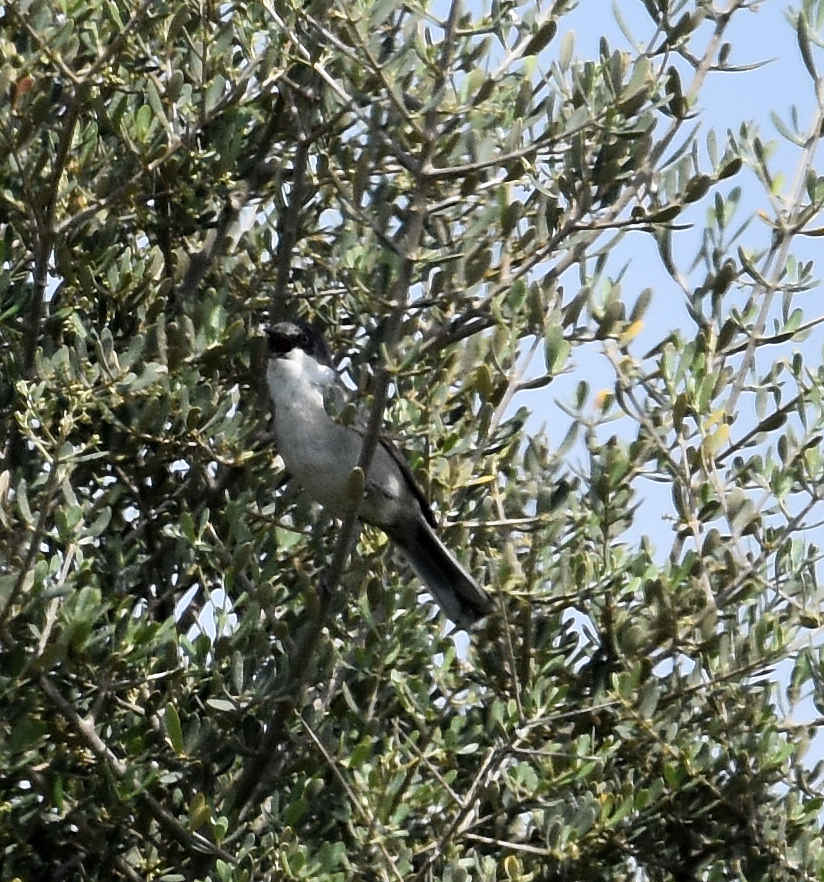
Nightingale and Orphean Warbler
I remember sheep bells clonking and clanking; gently and softly as they graze in the fields and olive groves and at other times jangling more urgently as they are driven down from the pastures to be milked. In one place it was possible to simultaneously hear the loud hoarse rasping chant of a Great Reed Warbler side by side with the complex rounded musical song of an Orphean warbler.

Poppies and lavender sp.
Wild flowers everywhere. Olive groves carpeted with white daisies. Roadsides and field margins spangled with poppies. Not our regular cadmium red poppies but a much deeper darker blood red. On the edges of the woodland, broom is in flower, shooting sprays of yellow into the air like frozen sparks from a roman candle.
Watching more than two hundred Glossy Ibises in fresh breeding plumage, feeding in shallow flooded pools at Kalloni salt pans. In the sunlight they are iridescent in shades of deep purple brown and black. They feed in a loose scrum probing for worms in the soft muddy grassland.

Glossy Ibises
They are watched by four or five Squacco herons and at the far side of the pool three drake Garganey keep close company with a female. Their spring plumage is immaculate. They are completely smart, clean and tidy – designer ducks, if there were such a thing! Overhead a Whiskered Tern flies round stooping to pick insects of the surface of the water.

Whiskered Tern and Squacco Heron
Standing at the roadside at Kavaki watching male Ruppell’s Warblers singing their scratchy songs from the top of cliffside bushes. They are surely one of the most stunning of the Sylvia warblers – the Collins Field Guide simply describes them as “unmistakeable”. A male Subalpine Warbler sits out briefly in the open and then I’m not so certain that the Ruppell’s is the most attractive member of the family! Behind the warblers on a prominent boulder a Blue Rock Thrush stakes his claim to the cliff.


Ruppells Warbler Subalpine Warbler and Blue Rock Thrush
A newly cut hayfield liberally sprinkled with Yellow Wagtails newly arrived and on passage to central and northern Europe. They march purposefully over the drying grass picking up insects. The females are subtly different from each other but the males are very different and reflect the eight or so different European races and geographical variations. There are black headed individuals at one extreme and then a range of subtle variations in blues and soft greys with differences in supercilia and neck patterns.  


Yellow Wagtail subspecies
We scan through them eagerly but in this party we are unable to find my desired Citrine Wagtail, a species I had never previously seen. Later down at the ford at Fantomeni, much to my delight we found one picking its way over the rocks in the stream. It was a sparkling male, resplendent in the sharp lemon-yellow plumage from which it gets its name.
Male Citrine wagtail
There were many other moments and very special birds that come to mind. Corn Buntings and Crested Larks being the default birds in the island and an amazing range and numbers of waders feeding unconcerned beside us at the salt pans.


Top picture Marsh Sandpipers below Black-winged Stilts
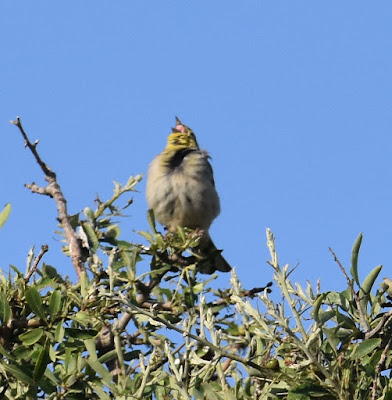
Pratincoles, Orioles, Rollers, Shrikes Flycatchers and both Pallid and Montague’s Harriers all showed brilliantly for us in different places. We found all the “specials” such as Kruper’s Nuthatch, Rock Nuthatch and Cinerous bunting. Lesvos in April is a great birding destination and to see it at its best you do not have to join an expensive tour.

Cinerous Bunting
The island has had a bad press because it is near to the Turkish mainland and has been used as a gateway to Europe by large numbers of refugees and migrants. The migrants just as the birds do, regard it as a stepping stone, a passage stop on the way to somewhere else, they don’t want to stay there, and the islanders are reluctant to host them. It is a complex, sensitive matter and an issue that should concern us all.  However, it is not a reason to avoid Lesvos, we saw no evidence of the problem but heard about the anxieties of the islanders who are dependent on the tourist trade. I would never wish to dismiss or diminish the scale of the problem, but it is not a reason to stay away from this birding hotspot.


All Pics from Lesvos (c) Bark

Tuesday, 24 April 2018

21st and 22nd April

Last weekend Bark said that spring had finally arrived, and this week it felt like we had gone straight into summer. With the hottest April day recorded in the country for 70 years, and with a hot weekend forecast crowds of people came down to the moor to enjoy the birds, wildlife and countryside walks. The weather also helped the migrating birds as more of the regular summer migrants swelled the ranks of the early arrivals to fill the hedges, skies and reed beds. The Blackthorn bushes are full of blossom and the sunshine this week has really got the leaves going on the trees and bushes.

Blackthorn in bloom

Lots of different warblers can be heard from the car park, and if you listen carefully you can hear the distant reeling of a Grasshopper Warbler reeling in its usual area up by the feeders. Blackcap, Willow Warbler and Chiffchaff soon followed. The walk from the car park to the main bridleway had more warblers singing away, while some were hidden in the bushes, others decided to get on the top of the bush to blast out their song. The skulking Lesser Whitethroat kept hidden away, as did the Grasshopper Warbler, but the Sedge Warblers could be seen near the tops of the bushes with their heads back singing away. A Whitethroat perched on the wires along the track and had a quick burst of song before diving for cover. Lesser Whitethroats are calling from all over the moor but so far there aren’t as many Common Whitethroat about. I expect they will soon arrive in numbers and be spread over the moor as usual by next weekend.  Cetti’s Warblers were easily picked up around the moor as they blasted out their song, often as you have just walked past. A Grasshopper Warbler was quite showy half way along the track to the first screen in the same place as last year. Garden Warblers were new arrivals this week and could be seen along the Roman road and the main bridleway, out in the open in the same area as last year. With Reed Warblers singing in the ditch around Greenaways it doesn’t take long to notch off the ten warblers that are usually found on the moor each year. With patience all the warblers can be seen well on the moor. There’s still time to pick up a passing Wood Warbler so hopefully one will drop in this week to keep the year list ticking over.

Sedge Warbler

Garden Warbler

There have been a few sightings of Wheatear on the moor this spring and even though the number of sighting may be down on previous years there were three around the cattle pens on Friday, one on the Closes on Saturday and two on Big Otmoor on Sunday.

Wheatear

With clear skies some of the raptors stretched their wings and circled up high above the moor. Red Kites, Buzzards and Sparrowhawk all circled overhead. A Peregrine was seen out on its regular post on Sunday on Greenaways and the regular Marsh Harriers were seen coming and going over the reed bed area. A single Hobby was seen on Friday evening and another three were seen on Sunday which were new for the Otmoor year list.

Hares were dotted around the reserve and can be seen quite easily at this time of year. The sunshine encouraged the Grass Snakes and Common Lizards out into the open along the bridleway and at the Lizard Lounge in front of the first screen.

Common Lizard

Ravens can often be picked up by their kronking call and one was seen flying over towards Oddington and two were seen drifting up high on a thermal over Greenaways. Woodcock and Jack Snipe were both seen over the weekend and were probably passing through. Booming Bittern was heard from the reed bed and three were seen flying over in the week. Grey Herons can be seen on nests in the reed bed and around the moor hunting for food.

Grey Heron

Even though there are a good number of birds singing away on the reserve the Skylark must take the prize as the most persistent as they are all over the reserve brightening up the day with their song filling the air. Meadow pipits were heard singing out on the moor and Cuckoos were heard more often than they were seen however there are at least three flying around the area.

Cuckoo, courtesy of John Reynolds

A Curlew was seen chasing off a Red Kite that must have got too close for comfort south of the reserve and others were calling off to the east. Snipe have started drumming and are a great addition to the sounds on the moor at this time of year. There is still at least one Black Tailed Godwit on Big Otmoor and another new addition to the year list was a Whimbrel seen out on Big Otmoor. These birds are often picked up each year flying over so it was nice to see one hanging around on Saturday and Sunday.

Curlew

Without doubt the bird of the weekend was a Pied Flycatcher and was seen by two of the weekend regulars. A great bird for the Otmoor year list and quite a difficult one to catch up with in Oxfordshire each year. Unfortunately it didn’t hang around and even though we searched all over for it we couldn’t find it again. It just goes to show that things are passing through and you have to be out and about to pick them up. Who knows what new birds will be added to the list over the coming week, hopefully something new for the reserve, well you have to live in hope!


Cheers

PeteRoby

Monday, 16 April 2018

Saturday and Sunday 14th and 15th April

Chiffy (c) JR

Full on spring seems to have happened at last, after what has seemed an interminable wait. Saturday morning was the epitome of a spring morning on the moor, with the first Cuckoo calling from the Roman Road and both Whitethroat and Common Whitethroat singing in the carpark field.  On Saturday morning there was a good scatter of Blackcaps singing in the hedgerows and there were several Sedge Warblers staking claims to territories with their demented, frenetic songs.
Sedge warbler being shy (c) Bark

Willow Warbler (c) Bark
It was as if a dam had finally burst and new sounds and fresh life were flowing in through the gap. Chiffchaffs and Willow Warblers were in full song from he bridleway and one Chiffchaff was so stained with yellow from the pollen of the pussy willow around it that, but for its song it would have been tricky to identify.
Chiffy covered in pollen. (c) Bark

There is a steady trickle of passage waders going through with three Black-tailed Godwits out on Big Otmoor on both days this weekend and a very elusive male Ruff. Redshank are everywhere one looks and have two pairs of Oystercatchers spending time both on and off the reserve. They flew low over us on Saturday morning and what fell on my head demonstrated that it is not just RAF Tornados that are adept at precision bombing!
Reedbed Teal (c) Bark

There were still significant numbers of ducks on the Big Otmoor pools and fifty or sixty Teal still on the reedbed lagoons. There are still Wigeon and a minimum of ten Pintail on Big Otmoor. Four Shelduck have been commuting between Noke Sides and Ashgrave, they are often present at this time of year but as yet we have no evidence of breeding attempts.
Little Egret (c) Bark
A Little Egret was stalking the margins of the Ashgrave pools presumably in pursuit of frogs, whilst in the reedbed Herons come and go to their hidden nests. It has now been proved that there are two booming male Bitterns on the moor, one in the main reedbed and the other in the linear reedbed nearer to Noke. Timed observations of the booming on Thursday evening proved that there must be two, short of having just one bird with a cloak of invisibility!
smart pair of Gadwall on Ashgrave (c) Bark
A dead goose out on Ashgrave has attracted a pair of Ravens that were spotted several times over the weekend flying in to feed and then flying off, presumably to feed young. The Marsh Harriers are very active both over the reedbed and the wider fields of the reserve. The male Hen Harrier is still with us, immaculate now in full adult plumage. It seems to be hunting further afield over the moor and is not always staying distantly on the far sides of the field. Barn Owls too are putting in regular appearances and hunting both at dawn and at dusk.
barn Owl (c) JR

With the presence of Whitethroat and on Sunday at least three Lesser Whitethroats the Otmoor year list is leaping ahead. There was a male Redstart in Long meadow on Friday and only this morning the first pair of Garganey of the year were spotted. The list currently stands at one hundred and twenty. Next week I expect it to go even further but I will not be there myself to record it……..I will be watching much less exciting things in Lesvos. Fortunately Steve and Pete will be filling in in my absence and I just hope that that they don’t turn up anything too exceptional.
Pristine Peacock (c) Bark