Tuesday, 14 February 2017

Saturday and Sunday 11th and 12th February

Redwing (c) Tom N-L
It is often said that to truly appreciate a place one should see it all its different moods, if that is the case this week Otmoor was deeply depressed and dolorous. It was unremittingly grey and colourless with sleet and drizzle. I had the feeling that it couldn’t even be bothered to snow or rain with any conviction or effort.
                                         There is a leuchistic Reed Bunting by the hide.

The birds were keeping their heads down, except along the path by the hide where the winter feeding is being carried out. The lack of seeds and food for finches is approaching the most critical part of the year and there were very large numbers of the usual seed eating species feeding on the ground and occasionally flushing up into the hedgerow beside the track. It was good to see at least ten Yellowhammers amongst them and very pleasing to see twelve Stock Doves on the ground, although they are wary of venturing too close to the hide. They are overlooked beauties with the subtlest range of greys and purples in their plumage, which I have to say looks very much better in sunshine, which this weekend was totally absent.
Stock dove (c) Bark
Fieldfare (c) Tom N-L
As we arrived in Saturday morning the sky across Ashgrave and big Otmoor was filled with birds clearly flushed by a major predator like a Peregrine. Ducks, Lapwings and Golden Plover made up the bulk of them but there were several hundred starlings scattered amongst them. We walked half way along the bridleway towards Noke, Big Otmoor was thronged with birds and we estimated several thousands of both Lapwing and Goldies. There were also closely packed parties of Wigeon moving grazing on the grass, but close enough to get into the water if they felt threatened. I spoke to Fergus the Assistant Warden who had just arrived and told him of these huge numbers of birds. I met him again an hour later and he said that the highest count he had had was about forty Wigeon. It was the same on Sunday morning in the same places that I had seen huge numbers of birds on Saturday there was just a smattering. I have just heard from the Reserve staff that when they did the WEBS count this morning the numbers were right back up again close to the winter maxima. The duck count included nearly one hundred Pintail.
Throng of Lapwings on Monday (c) Tom N-L
As is usual on a large reserve like Otmoor with a range of different habitats, the “hotspots” change with the seasons. Despite the fluctuation in numbers Big Otmoor is definitely the place to watch at the moment. It is looking great for both ducks and waders. On Sunday we heard a Grey Plover calling from the northern edge of the field or perhaps even Noke Sides. We were unable locate it on the ground but nonetheless it is the ninetieth species to be recorded this year on the moor.
hare last weekend when it wasn't so wet (c) Bark
Up in the scrubby area on the higher part of Ashgrave there are two pairs of Stonechats. They are taking advantage of the rough scrub that is growing up and the shelter of Sling Copse.

Peregrine and Marsh Harriers as well as the ubiquitous Kites were the most obvious raptors this weekend. Sadly the Short-eared Owl has abandoned its regular perch in the car park field. I hope it has gone through choice and not because it was disturbed by anyone. The warmer weather forecast this week should start to bring in the first of our breeding Redshanks and for the next four months every visit will be accompanied by their calls.
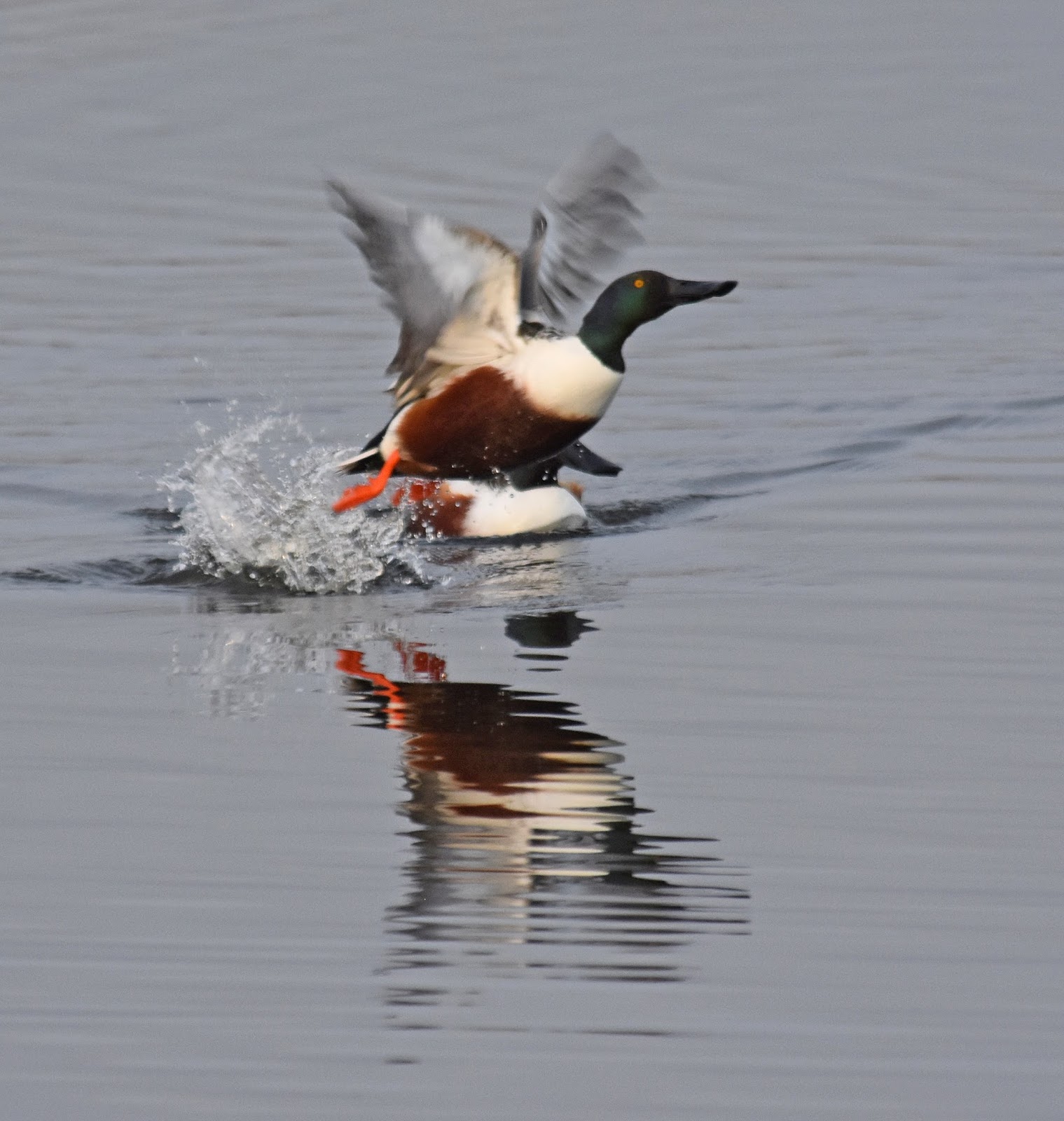
Shovellers (c) Bark

Tuesday, 7 February 2017

Saturday and Sunday 4th and 5th February


Yellowhammer (c) Derek Lane

It was an exceptionally “birdy” weekend on the moor. There were new species for the year list and also a first for Otmoor (not tickable)! Most exciting however were the sheer numbers of birds to be seen. The wet weather of last week has meant that water levels have risen and Ashgrave and especially Big Otmoor are optimal for large numbers of birds.
Golden Plovers and Lapwings are predominant with conservative estimates of over three thousands of each. It is very difficult to be accurate as both species are broken into separate large flocks and are moving from field to field. It is sometimes possible to track the progress of an over-flying Peregrine or Harrier as different flocks take flight in sequence across the whole reserve.
Snipe and Teal from the first screen (c) JR
Big Otmoor is also perfect now for ducks. There are several hundred Shoveller taking advantage of the newly flooded grasslands. There were very large flocks of Wigeon grazing across both this field and Ashgrave. Out in the middle we counted more than twenty five Pintail, both displaying to the females and also upending to feed. Teal are spread across the whole of the moor now but are concentrated on the reedbed, they too are present in significant numbers. On the northern reedbed there are pairs of Gadwall and the number of Pochard is now well over twenty five. Tufted Ducks have reappeared after being missing when the lagoons were partially iced over. As the water levels on the reedbed have risen the Snipe have been pushed closer together to roost and we counted at least fifty huddled together on the small mud bank straight across the water from the first screen.
Pied Wagtails pick their way around the margins (c) JR
Once again we saw three different Marsh Harriers present. Two of them are spending time perched up close together on bushes between the reedbed and the flood field. The Hen Harrier was also seen this weekend and again there were several Bittern sightings. It will soon be time to start listening out for booming males in the early mornings.
Shelduck over (c) JR
We heard Curlew on Sunday morning. The calls were coming from two different directions and so we knew that there were more than one. They have turned up right on cue although as yet in smaller numbers than is usual. Black Tailed Godwits were a welcome early addition to the year list. There were nine seen, out on Ashgrave, on Saturday afternoon and on Sunday morning we picked up five in flight over Big Otmoor they landed in the north eastern corner of the field and were feeding busily.
Two Egyptian Geese flew over the hide and out onto Ashgrave on Saturday and two Shelduck were on Greenaways early before relocating to Ashgrave later.

Budgie (c) Derek Latham

The first ever Budgerigar to be recorded on Otmoor was seen on Saturday afternoon near the first screen! If it can find the seed feeding site beside the hide, it might very well be able to survive (we even put millet out) however I don’t really know how readily they can survive the cold. There are three Cetti’s warblers out at the reedbed and others along the bridleway.

A pair of Stonechats are still out on Greenaways and seem to be surviving the colder weather well another pair were hunting from the fence around Big Otmoor. We have been surprised at the number of Robins that we have seen this winter. There are regularly four or five in the car park alone and others accompany us along all the paths and bridleways.
One of very maby Robins (c) Derek Lane
It was beautiful looking out over Big Otmoor on Saturday morning in the sunshine, the blue sky reflecting in the pools, ditches and scrapes. Scoping across the field from the bridleway the bright colour of the drake Wigeon and Shovellers shone out along with the iridescent green of the Lapwings. On Sunday morning a Chaffinch was singing in the oaks and two Skylarks were calling and chasing each other over Noke Sides. Hares were beginning to act “madly” chasing and boxing with each other. It is still February but spring is only just around the corner.


Otter in the ditch on Sunday. Top picture two weeks ago. (c) Derek Latham

Wednesday, 1 February 2017

Last two weeks in January

Short-eared Owl (c) Derek Latham
I missed blogging last weekend due to a trip abroad and so will fit in a fortnights events in one posting. It is significant over the last few weeks that not very much has changed on the moor, we are in the mid-winter doldrums, a pause before the first migrants start to arrive and leave.
We have had a period of sustained cold with most of the open water having iced over for much of this time. This of course makes for severe difficulties for wildlife but fortunately it was not quite cold enough to totally freeze the lagoons and on most days, the temperature rose just a bit above freezing.
Waiting for the thaw(c) JR
The same suite of birds is still on the moor. Lapwing numbers have risen steadily but the Golden Plover are much more erratic, sometimes present in huge flocks and on other days, such as yesterday, in a flock of thirty at the most.
The Starling roost is declining slightly and its main action is shifting to the northern reedbed and to the hedgerows. The scale of the damage that they do to the reeds is now very clear.
Starling (c) JR
The same set of raptors too, are still in residence. It seems likely now that there are four different Marsh Harriers present and they may represent two distinct pairs. Two different Peregrines are also being seen regularly.
Peregrine (c) JR
This Sunday we saw the smaller male make at least four passes over the reserve and on one occasion snatch a prey item from the mixed finch flock beside the hide. It then flew out into the middle of Ashgrave where it sat for the next half an hour, clearly digesting its meal. A pair of Red Kites have taken up squatter’s rights on the old nest in the large oak tree on the eastern edge of the reedbed. Their behaviour is very territorial and they seem to spend a deal of time clashing with the Marsh harriers. On Saturday morning, we saw one of them rob a harrier of its prey.
Harrier and Kite (c) Derek Latham
It has also been easy for them to pick up the inevitable casualties that are bound to occur around a roost of nearly a hundred thousand Starlings. Merlin has made occasional appearances as one did on Sunday. The Short-eared Owl in the carpark field has attracted very many admirers. It is site faithful and is very happy to be observed from the track. It would be extremely disappointing if anyone were to try to get any closer than the gate and so risk the bird abandoning its roost.
The secretive Owl
Wigeon numbers are around their winter maxima and we have had a small influx of Pochard with at least ten birds present on Sunday. Likewise, there are now a small number of Pintail out on the far pools on Big Otmoor. Teal too are present in good numbers but given their habit of lurking deep in the reedbed they are very difficult to count.
Bitterns continue to be seen regularly, moving within the reedbed and occasionally flying in from the vicinity of the River Ray.
It has been great to hear that Otters have been seen again on the reserve, they have been absent for a while. Their presence might help to deter the Mink that are a particular problem for our ground and reedbed nesting species.
Songthrush along the bridleway (c) JR
I took a trip out to Over Norton on Friday to catch up with the Little Bunting that has been found at the feeding station set up beside a small copse. The feeding programme is very like  the one that we are undertaking beside the hide and they are scattering a similar amount of seed each week. It has made me all the more determined to carefully go through the hundred or so Reed Buntings that are currently taking advantage of it. I can imagine that such a bird could easily in slip under the radar when so many birds are coming in and out to feed.


Linnet, Reed Buntings and Goldfinch in the frost (c) JR